

Learn to Recognize These 12 Common Rabbit Diseases, Illnesses, and Ailments
When you introduce a rabbit into your family you are not only committing to provide it with a loving home but also to take responsibility for ensuring that it is happy and healthy. An integral step in keeping your newest family member safe is learning to recognize the signs and symptoms of these common rabbit diseases and illnesses.
The most challenging aspect of keeping your rabbit healthy is the fact that they will go to great lengths to hide any signs that they may be sick in order to avoid being seen as ‘easy prey,’ making them vulnerable in the wild.
For this reason, rabbit owners need to ensure that they are highly observant when it comes to their furry friends, paying attention to even the slightest change in their daily behaviours.
This, coupled with regular health checks from your veterinarian, a healthy diet, up-to-date routine vaccinations, and a carefully constructed safe living space will increase your rabbit’s chances of living a long, happy life!
Many of the most common illnesses that a rabbit may face can be prevented or treated effectively, so long as you take the time to educate yourself on the important facts about rabbit ownership.
Related: ‘Easy Homemade Rabbit Toys Using Recycled Materials‘
Here are 12 of the most common domestic rabbit diseases and illnesses:
Heat Exhaustion/Heat Stroke
This summer has been a hot one, sending many of us in search of the nearest air-conditioned building to cope with the blistering heat.
At times like this, it is important to remember that we aren’t the only ones that may be struggling with handling the high temperatures.
Just as we can suffer heatstroke, so too can our rabbits. Ensure that your rabbit is kept in a cool, shady location with access to plenty of cold, fresh water.
Signs that your rabbit may be struggling with the heat include fast, shallow breathing, wetness around the nose, tossing of the head, ears that are hot to the touch, or acting listless.
If your rabbit is showing any of these signs, ensure that they are in a cool area away from the sun.
Take cool (NOT cold) water and gently dampen the ears, as this is one of the most effective ways to lower a rabbit’s body temperature.
After taking these initial steps to deal with the immediate risk, contact your veterinarian for further instruction.
Bumblefoot
Bumblefoot, more commonly known as ‘sore hocks’ in rabbits is a condition in which a rabbit’s feet become raw, irritated, or inflamed.
This can be caused by a number of different conditions, most of which are completely preventable.
This includes friction on the feet from poor padding or a lack of fur on the bottom of the feet, obesity, poor flooring in their living conditions, or skeletal problems such as arthritis.
When you are setting up your rabbit’s living space, ensure that they are not left to walk on hard wire flooring, wood, tile, linoleum, or slick plastic surfaces.
All of these types of flooring can cause problems with their feet and joints over time.
It can also be caused, or further irritated, by having to spend time in dirty bedding or litter boxes.
Keep your rabbit’s living space clean, providing for adequate padding on the floor.
If you notice your rabbit limping or favouring one foot, it may require your attention.
In most cases, bumblefoot can be treated rather easily through proper cleaning and bandaging, medication if necessary, and correcting the cause of the problem.
Your veterinarian can help you to ensure you avoid any additional infection from this condition.
Related: ‘11 Must-Have Apps for Pet Parents in 2020‘
Snuffles
While it is normal for us to show signs of a cold, this isn’t the case for our pets. Don’t fall into the trap of shrugging these signs off as nothing to be concerned about.
If your rabbit is experiencing nasal discharge, watery eyes, repeated sneezing, and matted paws, these are all signs of a bacterial infection known as ‘snuffles.’
This is a disease that is best prevented, which is done by simply ensuring that your rabbit is kept clean, in a clean environment, with a healthy diet.
However, if you do see signs of an infection contact your veterinarian as you will require antibiotics immediately for the best chance of fighting this off.
Ileus/GI Stasis
This is a condition that occurs when a rabbit’s intestine stops performing properly, failing to move food through effectively as is required for adequate digestion.
It is incredibly important to watch for early signs that there may be a problem, as untreated ileus will lead to death after only 48-72 hours.
As the food remains stuck in the intestine it will lead to a build of up gasses.
An infected rabbit will stop eating or going to the bathroom and appear lethargic and uncomfortable.
In order to survive ileus, you will need to seek care from a veterinarian for medications and fluid administration.
As the medication is working to reverse the condition, your rabbit will need to be fed green vegetable baby food and water by syringe to provide necessary nutrients.
Rabbit Hemorrhagic Disease
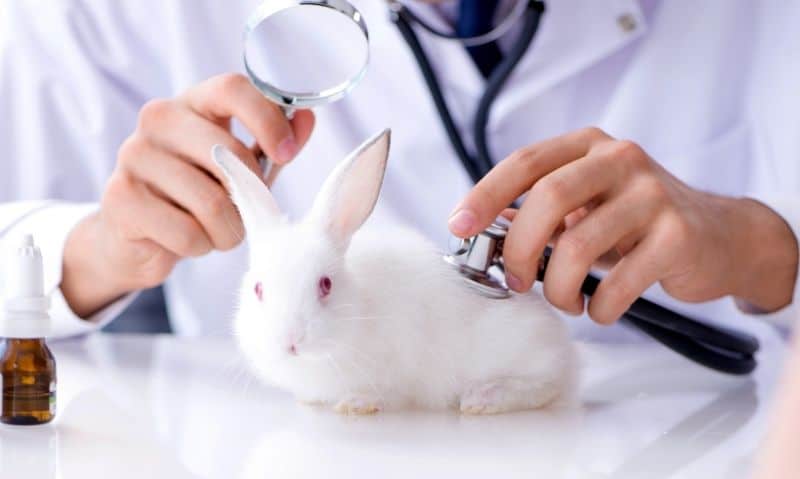
Also known as ‘rabbit calicivirus disease,’ rabbit hemorrhagic disease is highly infectious and often fatal when contracted.
As it only infects rabbits, some countries have even used this virus as a way to target a rabbit overpopulation, actively introducing it into the population.
The disease moves at a rapid rate, with an incubation period of 1-3 days, most rabbits will experience sudden death within approximately 48-72 hours of infection.
Signs include lethargy, restlessness, poor appetite, and fever.
Due to the rapid way in which the disease moves throughout the body its mortality rate is approximately 70-90%, and there is no treatment available.
The good news is that there is a vaccination that will protect against at least some strains of the disease. Speak with your veterinarian for more information.
Ear Mites
Ear mites are small parasites that, when they infect the ear or ears of a rabbit, cause extreme discomfort and, if left untreated, may lead to serious infection or hearing loss.
Common signs of an ear mite infestation include itching around the ear, neck, and head, hair loss on or around the ears, head shaking, or the presence of a brown, crusty buildup within the ears.
If you do notice any of these signs, good news – an ear mite infestation can be treated quickly and effectively with a visit to your veterinarian.
Related: ‘How to Care for Rabbit Teeth‘
Reproductive Tumours/Cancers
Highly common in rabbits, reproductive tumors often go unnoticed. This allows them to continue to develop, often resulting in a fatal condition.
Spaying and neutering your rabbit is highly recommended and believed to be the best way to avoid reproductive cancers.
Watch for growths in the genital and abdominal areas, discomfort, bloody discharge, or sudden, unexplainable aggression.
As with the treatment of cancer in humans, you need to seek professional assistance as soon as you suspect that there is a problem.
Reproductive cancers like uterine, ovarian, and testicular cancers are often fatal, especially if they are not caught until a late stage.
Your veterinarian will be able to complete necessary testing to determine what stage the disease is at, and which options you may have available to you.
Bloat
Bloat is an incredibly painful condition that can come on suddenly, and quickly lead to death if it is not immediately addressed.
It occurs when there is an accumulation of gasses in the rabbit’s stomach that are unable to escape.
Unfortunately, the causes are still largely unknown, although theories include overeating, lack of fibre in the diet, changes in diet, excessive drinking, excessive stress, or that it is a result of other digestive problems.
The prognosis is poor, however, if it is caught early enough subcutaneous fluids, corticoid drugs, antibiotics and the introduction of a rubber catheter to aspirate the gave have been found effective in some cases.
In most cases, the veterinarian will recommend humane euthanasia to avoid unnecessary suffering.
Signs of bloat include a distended abdomen, little to no appetite, failure to defecate, hunched posture, grinding of your rabbit’s teeth, decreased activity, lethargy, and weakness.
Seek veterinarian assistance at the first signs of a problem.
Hairballs
If you have previously owned a cat, then the idea of your pet having hairballs certainly isn’t a foreign concept.
This is a rather common struggle for many cat owners.
There is one distinct difference, however, when you are dealing with a rabbit. Rabbits can’t vomit in the way that a cat can, bringing the hairball up.
This is a necessary, albeit it sort of disgusting, response. Instead, hairballs will sit in a rabbit’s stomach continuing to grow and creating a blockage that can cause serious digestive problems.
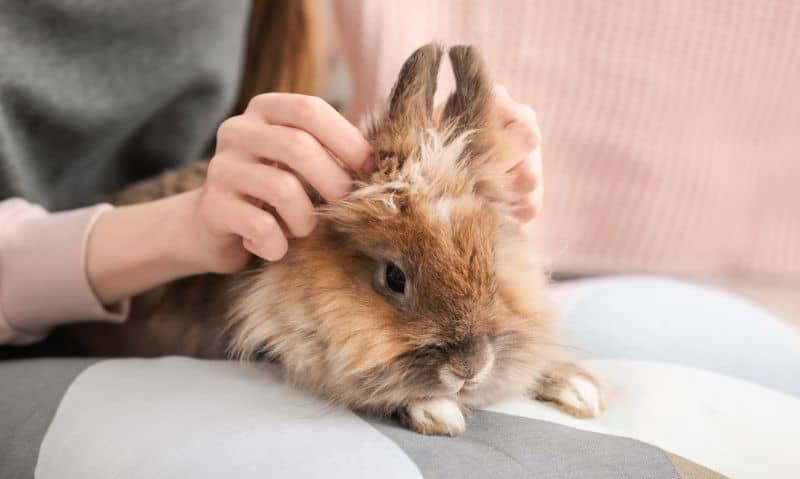
The best thing you can do is prevent hairballs from forming by grooming your rabbit regularly and by ensuring that they always have access to cold, fresh water.
If you notice your rabbit is showing signs of discomfort, eating less or not eating at all, failing to go to the bathroom, or chewing on sources of fibre like the paper or shavings at the bottom of the cage then seek a veterinarian’s assistance.
They may provide you with something to break down the blockage or, in severe cases, it may require surgery.
E. Cuniculi
A microscopic parasite that infects the brain and kidney of the rabbit, e. cuniculi may be carried for a long time without any sign of illness.
However, if the infection does take hold it can have serious consequences.
Signs of infection include weakness in one or both hind legs, paralysis, uncontrollable rolling or spinning, drinking or urinating more than usual, head tilting, seizures, deafness, cataracts, behavioural changes, or shifting of the eyes from side to side or up and down.
As many rabbits are actually infected by their mother at a young age.
However, if you catch the infection early it can effectively be treated with an oral medication from your veterinarian.
Contact your vet at the first sign that something is ‘off.’
Related: ‘How to Litter Train Your Rabbit‘
Myxomatosis
Transmitted to rabbits by fleas, mosquitos, or close contact with an infected rabbit, myxomatosis is caused by the myxoma virus.
This disease is fatal in nearly all cases with the mortality rate estimated to be at approximately 96%.
For this reason, it is incredibly important to take steps to prevent infection.
Domestic rabbis do not possess any natural resistance to the virus, and there is currently no vaccine available.
You need to focus on preventing exposure to the virus by protecting your rabbit from biting insects and avoiding contact with infected rabbits.
If your rabbit is kept outdoors, ensure that its living quarters are protected with mosquito netting.
It is also incredibly important to keep up with your rabbit’s flea prevention.
Signs of an infection include swelling and discharge from the nose, eyes, and genital region.
Treatment is rarely successful, and in most cases, the best thing you can do for your rabbit is to humanely euthanize them before their suffering is too great.
If you have lost a rabbit to myxomatosis take great care to clean and bleach anything your rabbit has touched including water bottles, food dishes, litter boxes, bedding, and your rabbit’s living space before bringing another rabbit into the space.
Problems Relating to the Teeth
Unlike cats and dogs, a rabbit’s teeth are continually growing throughout their lives.
In the wild, their teeth are worn down by grinding their food. Domestic rabbits, however, often eat a diet that doesn’t require the same level of work for the teeth, allowing them to grow out of hand.
Overgrown teeth are often painful, sometimes even curling back into the gums or the cheeks.
It can also prevent your rabbit from eating effectively, leading to malnutrition and ultimately starvation.
In order to prevent this from happening, your rabbit should be provided with items to help keep the teeth ‘trimmed’ such as hay, alfalfa safe wood varieties to chew on.
If you do notice your rabbit’s teeth are getting too long, or that your rabbit’s teeth have become abscessed in some way, contact a professional for assistance in managing the situation before it becomes a much larger problem.
What steps do you take to protect your furry friend against these common rabbit diseases?

I am reading this post even though my pet bunny died a couple of years ago. I still think about him often. I’ve been wanting to have another one but don’t know if I have time. I actually had two but the other one died when he was a baby. I had no clue why.
I am so sorry for your loss!
I didn’t realise that rabbits were susceptible to so many different diseases. I knew that cats got fur balls but was surprised that rabbits can get them too. There’s a lot to consider before getting a rabbit as a pet.
There definitely is. New rabbit owners have A LOT to learn which can be overwhelming, but when you bond with your rabbit, it’s all worth it!
I have often thought about adopting a rabbit into our household but as I have never had a rabbit before, I honestly never knew about half of the issues you have shared here. The first thing that worried me is when you pointed out that rabbits essentially hide any sign of ill health instinctively. This of course makes it harder for you to detect things that other animals would be more open about. Reading through these 12 common diseases gave me a whole new appreciation of things that you need to be alert to and that are quite unique to rabbits. I’m so please I read this and have a much greater appreciation of what is involved with having rabbits.
It definitely can make it hard! Many animals try to hide their pain, but some are better at it than others – rabbits fall in that category!
each pet has issues with health both pontionally and actually. I think it’s nice where to pay more attention to care for your pet better
It’s so true – that’s why it’s important to do your research and learn as much about your pet as possible.
Hi Britt. Love your blog and love how you write and care about pets. Every time I read one of your posts, I super appreciate how you write everything in detail, but also include pics and the fact that you care for pets shows up in your writing. Happy Holidays and all the best for 22. Look forward to your great work in 22 and thanks for introducing debbie to the pink group.
Thank you!
I had no idea rabbits got hair balls just like cats do. Or that their teeth continually grow. I’m always amazed at the things I learn from your blog, Britt! I have a friend who has rabbits on her mini farm, so I’m passing this post along, just in case they can learn something new!
That’s the thing with pets, there’s always something more to learn. I’m learning new things every day 🙂
The level of detail within your blog posts is insane….in a good way. Very useful, helpful and informative reading that helps to make sure pets lice a,more comfortable life x
Thank you!
Growing up my parents would not let us have a rabbit because they felt like it was too much to take care of two to the number of issues that can occur. I really appreciate you going into just about how to take care of different animals
Each type of pet out there has its own unique concerns. One of the best ways to choose the right pet for your family is to start by learning all about it and choosing one that you’re prepared to care for. For some, the health concerns of a rabbit are too much while others will happily take on that risk, educating themselves in all the signs and symptoms. I’m a firm believer there’s a ‘best fit’ for everyone in the pet world!