
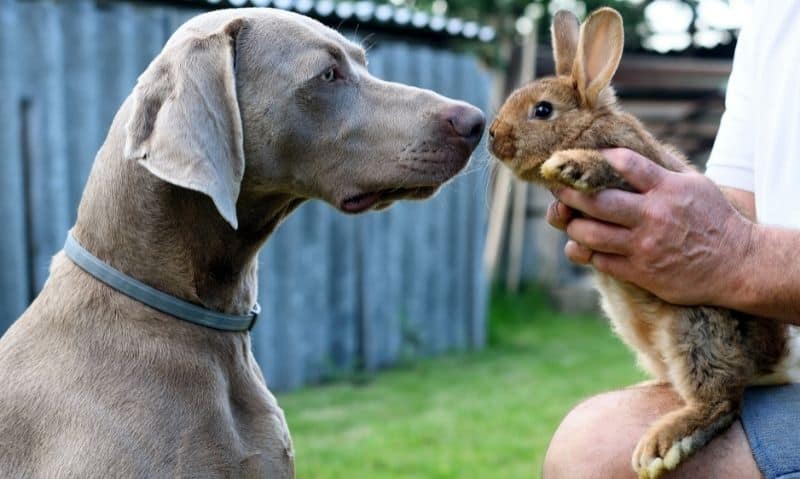
How to Introduce A Rabbit to Your Dog*
*GUEST POST
There are many variables to consider when it comes to introducing a rabbit to your dog. In general, though, dogs may be taught to accept a rabbit and educated accordingly.
However, if you’re able to choose the dog or rabbit breed, their personality features might greatly influence whether or not they will get along with their animal partner.
Your rabbit will be better off with a couch potato dog breed, such as a lap dog. When it comes to rabbits’ personalities, it all depends on the breed.
Keep an eye out for breeds that are more flaccid than their wild cousins like the Havana and Havanese. Larger animals, such as dogs, are less of a threat to these bunnies since they are used to companionship.
First thing to do is to Pick the right pet
Investigate the existence of dogs that are nice to rabbits.
If you’re thinking of getting a dog, be sure it’s rabbit-friendly before you make the commitment. Dogs who are inclined to hunt and chase down small animals, such as rats and rabbits, should be avoided.
The hunting tendencies of these breeds are well-known in the dog community.
The personality of a dog may not be entirely determined by the dog’s breed. Observe the temperament of your dog before introducing them to any other animal.
Pick a rabbit that is amiable to dogs. Rabbits come in a broad range of breeds and dispositions, much like dogs. You want a rabbit that will get along with your other pets, so look for one with a kind disposition.
The following breeds are recommended for socialization: Sussex, Himalayan, Dutch, Californian, Havana.
Consult with a veterinarian. Consult your veterinarian before bringing any additional pets into your house.
Maintaining the health and well-being of your present pets is an important consideration. Stressed or injured animals may be more prone to aggressiveness.
Your veterinarian will be able to do a thorough examination of your pet and provide you with any particular instructions you may need.
Getting ready for Preparation
Make sure your dogs are healthy and checked out by a vet before you even consider the first contact.
It is possible that both rabbits and dogs may have infectious illnesses or germs that might be harmful to each other because of their distinct immune systems.
Before introducing a new pet into your home, make sure your dog is in good health and enquire about any necessary safety precautions.
Inquire about a rabbit’s prior health, vaccinations, and parasite treatments before purchasing or adopting one. You should always put your pet’s well-being first.
Don’t forget to put your dog through his paces: It’s the dog who’ll be on a leash and set go with the rabbit when the time comes. So, it’s critical that your dog be properly socialized and taught to obey orders before he can do so.
If your dog doesn’t know what you’re saying, it won’t trust you. “Sit,” “stay,” and laying down are the most basic orders, followed by “drop it/leave it” and “back away,” which are more advanced.
Even if the dog’s reaction is constant, it is impossible to predict whether the rabbit’s movement would set him off and cause him to go hunting if he has not yet been properly taught.
Always reinforce excellent conduct with a prize, such as a treat.
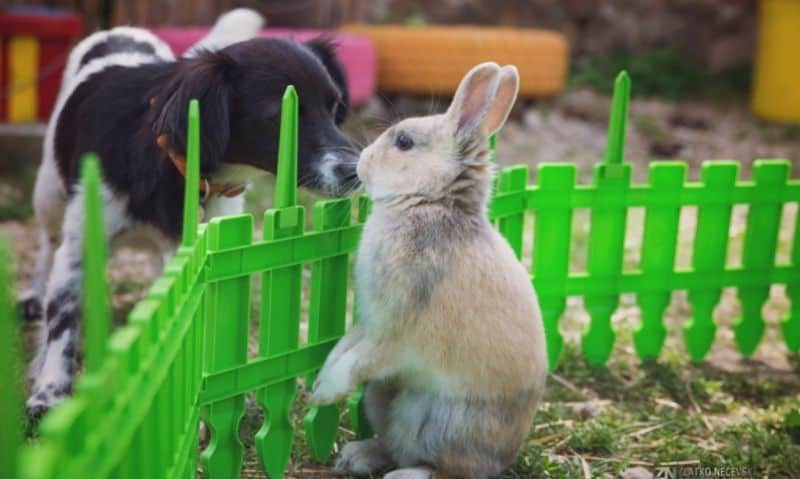
Steps to follow in the beginning
Locate a place that is free of distractions:
Find a place in your home where none of your pets spends any time to remove any territorial behavior.
It’s important for each pet to have a separate room for sleeping, eating, and playing.
Stress and distractions may be reduced by providing them an opportunity to meet in an unfamiliar location.
Keep the rabbit in a cage for its own protection
Some patience is required before your dogs can play together or at least tolerate each other without severe safety measures.
The rabbit must be kept in a cage or hutch during their first encounter.
It’s possible that your dog may get too agitated and thrilled, resulting in injury to the rabbit. The rabbit will be protected in a well-built and roomy cage, and he will also be able to flee to a quiet area and decompress if he becomes too anxious.
The dog must be kept on a leash
Dogs, like rabbits, should be contained in a crate or harness for their own safety.
An eagerness to explore and sniff for the rabbit will set in when the dog scents something new.
Make sure to keep the dog’s leash taut and ready to respond to any signs of hostility. To be safe, keep an eye on your dogs’ behavior and adjust your approach as necessary.
Stay cool and patient
Success in any endeavor requires patience and practice, just like any other habit.
Because the new pet is here to stay and most importantly, it’s neither their food nor an attacker, your pets need to be aware of this fact.
You should set out a definite time each day for your pets to meet and stick to it for a while. When you’re consistent and persistent, your pets will ultimately get along.
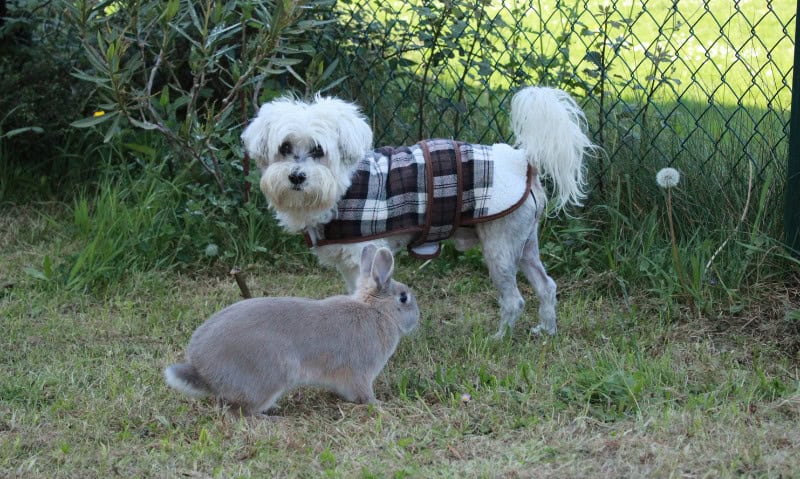
Look to your four-legged friends for guidance
Both animals will want to study and explore as soon as they grow used to each other’s presence.
Your job is to be a passive spectator and let the animals interact as they see fit. Rabbits may be territorial, so don’t be alarmed if you see the rabbit displaying signs of dominance and hostility.
Start by gradually reducing the substantial obstacles
It is possible to allow certain rabbits and dogs out of the cage if they demonstrate a high level of tolerance, like Great Dane Chihuahuas, but this is not always the case.
While another person takes care of the dog, you may carefully remove the rabbit from its hutch.
Slowly pull the rabbit closer to the dog while holding it firmly in your hands. The dog’s conduct should be observed and rewarded.
Taking the dog out of the room might help calm the animals down if they get too aggressive. Always be on the lookout for and discipline any aggressive or disobedient conduct.

In Conclusion
Learn to accept the fact that some rabbits and dogs are just not meant to be.
If you and your pets simply can’t get along after a lengthy period of trying and meeting, don’t attempt to push it. It might be because the dog has a great desire to hunt, or the rabbit is too frightened.
Feature Image Credit: JiriNovotny | Canva

About the Author
Esther van Praag, Ph.D. After obtaining her M.sc. from the Rijksuniversity of Leiden (the Netherlands), Dr. van Praag graduated from the Faculty of Agriculture, Food and Environment, the Hebrew University of Jerusalem (Rehovot, Israel) in 1996, with research on plant carbohydrate metabolism, and 3-D computer protein modeling in a joint-project with the Weizmann Institute of Sciences (Rehovot, Israel). She continued her training with 2 postdoctoral positions at the Dept of Microbiology, University of Zurich (Zurich, Switzerland) and at the Dept of Child Pathology, University Hospital of Zurich (Zurich, Switzerland). Dr. van Praag has always had a great interest in animals and has 20 years’ experience with pet rabbits.
You can see more from Dr. van Praag on MediRabbit.
