

Is a Cheap Rabies Vaccine or Low-Cost Vaccination Clinic Safe?
Recognized as the world’s deadliest infection disease, the rabies virus carries a very grim prognosis. In fact, with no known cure, the virus is almost always fatal.
It is for this reason that the rabies vaccine is a required vaccination in many areas.
If you have been researching options for a cheap rabies vaccine or low-cost vaccination clinic in your area but aren’t sure if it’s a safe option for your pet, today’s post is for you!
September 28th is World Rabies Day, an initiative spearheaded by the Global Alliance for Rabies Control.
This is a day where those of us in the pet space are encouraged to share information and help ease any fears or misconceptions about vaccination in an effort to do away with rabies once and for all.
In fact, they are currently working towards a goal to eliminate rabies deaths by 2030!
Here in Canada, rabies cases are incredibly rare. In 2024, the Canadian Food Inspection Agency recorded a total of 137 confirmed cases of rabies across the country.
Of these cases, only 1 was attributed to a dog while cats didn’t account for any cases.
I understand that the persistence of rabies as a modern-day scourge is due to our collective failure of responsibility. We can, and must, end the suffering that rabies causes, for the sake of both our human and animal friends.
Jane Goodall, PhD, DBE
What is Rabies?
Rabies is a viral neurological disease that can be experienced by any warm-blooded animal including wild animals like the raccoon, family pets, and even humans.
The disease attacks the brain and spinal cord, altering their temperament and ultimately causing a slow and painful death.
Unlike many diseases, there are no tests that can be conducted to determine if your pet has been infected.
The only effective way to test for the disease is by examining the brain tissue of the animal after it has passed, looking for evidence of infection.
There is no cure and, once an animal is showing signs of rabies, its estimated remaining lifespan is just five days.
Transmission of the disease occurs when an animal is in direct contact with the saliva of an infected animal.
It is most associated with a bite; however, it can also happen through a scratch or other existing wound being exposed to saliva.
What are the Signs of Rabies in Dogs and Cats?
If your pet has been exposed to rabies, the typical incubation period is between three and eight weeks.
However, there has been evidence that this can vary significantly, with some animals showing signs as early as nine days while others won’t show signs until several years after exposure.
The common signs and symptoms of rabies in a companion animal include:
- Behavioural changes (higher anxiety or friendliness)
- Aggression at other animals, people, or even directed at inanimate objects
- Sensitivity to light, sound, and touch
- Change in tone of bark
- Seizures
- Fever
- Excessive salivation or foaming of the mouth
- Inability to swallow
- Difficulty breathing
- Weakness and disorientation
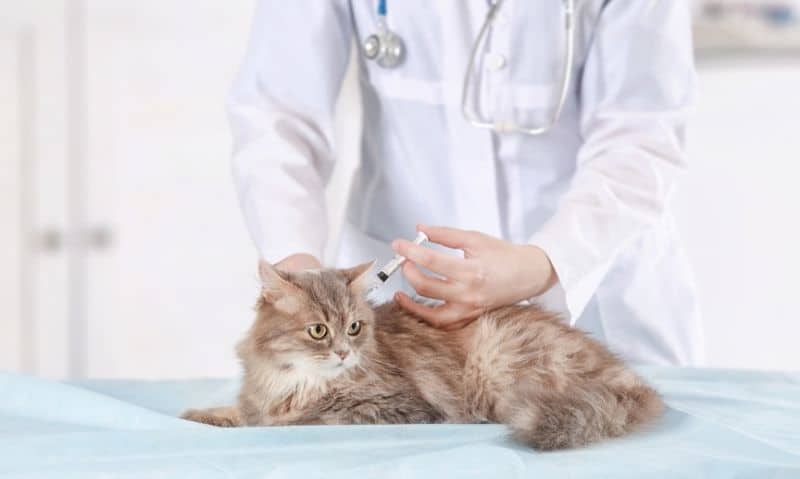
Rabies Vaccinations and Your Pet
As I previously mentioned, rabies is almost always fatal. For this reason, we need to prevent an infection from occurring to keep our pets safe.
For this reason, the rabies vaccine is a required part of pet ownership and veterinary care in many areas of the world including Canada and the United States.
The rabies vaccine is given every 1-3 years depending on the recommendation of your veterinarian and the local laws.
As a pet owner, it’s important to recognize that this is an ongoing cost that will continue for the full duration of your pet’s life.
While the vaccine itself isn’t overly expensive, there are often additional costs that you will incur at the time of your pet’s veterinary visit including the office visit fee and any other examines or treatment that occurs at the same time.
Often, you will see mention of low-cost vaccination clinics or cheap rabies vaccine deals being offered by local shelters or rescue organizations.
These clinics are offered to make veterinary care more accessible for all pet owners.
Is a Cheap Rabies Vaccine or Low-Cost Vaccination Clinic Safe?
The biggest difference at many low-cost vaccination clinics is the fact that your appointment solely covers the administration of the vaccine.
This means that it will not cover a full checkup and exam to catch any other potential health concerns.
They should NOT be viewed as an acceptable substitute for routine veterinary care.
In addition to not providing a medical examination, these clinics are often focused solely on vaccinating for rabies while overlooking other important diseases.
A full vaccination schedule for your pet should include consideration for other diseases that they may encounter such as parvo or distemper.
If you do use a low-cost clinic to take advantage of a cheap rabies vaccine, be sure to contact your veterinarian to follow up with any additional veterinary needs.
These clinics are set up to deliver as many vaccines as possible during a short period of time.
In doing so, they can minimize the expenses that they incur which then allows them to provide the vaccinations at a lower rate.
They often run for 1 or 2 days, requiring you to pay attention to when they pop up in your area.
While they are not the ideal situation, they do play a valuable role in the prevention of rabies by making this vaccine accessible to those that may otherwise struggle to afford it.
Without them, we would likely see an increase in the number of pets infected.
Returning to the question – Is a Cheap Rabies Vaccine or Low-Cost Vaccination Clinic Safe?
If you can afford an appointment with your regular veterinarian, that is the recommended approach for your dog’s overall health and well-being.
However, these clinics provide an important (and safe) service for those in need.

Have you ever used a low-cost clinic or cheap rabies vaccine opportunity? I would love to hear all about your experience in the comments sections!
Feature Image Credit: pixelshot | Canva

What an interesting post! I never really thought about domestic pets getting rabies but of course that makes sense that it’s not just wild animals. Such a horrible disease. I don’t have pets but if I did they would be my family and I would want them to be as safe as possible.
We are SUPER careful to stay on top of vaccines for our pets for exactly this reason – It’s such a horrible disease that can be prevented so easily.
Excellent post, Britt! I do keep up on my dog’s rabies vaccine, and I have come across a rabid skunk (who was going after one of my dogs, thankfully, it did not get her!) It’s a horrible disease. I’m curious as to why Canada’s numbers are (luckily) so low? Bravo to them! I’m Pinning this to share.
I would honestly be interested in seeing research on why the rates here are so low compared to other developed countries. Not that I’m complaining! I’m just curious what we could learn from the comparison.
Rabies is such a scary disease! I’m glad to see that it has been nearly erradicated in developed countries. I’ve used my regular veterinarian for rabies vaccines, but I think that the low-cost clinics are a great idea. They encourage people from lower income brackets to get their pets vaccinated against rabies. Wonderful article!
I am sure that there are many, many pet owners that wouldn’t otherwise maintain a proper rabies vaccination schedule which could lead to much bigger problems without these clinics. I have so much respect for those that give their time to making the vaccine accessible.
I used to volunteer for a nonprofit that offered low-cost basic services. They were a great resource for many that could not afford standard routine care with higher-cost veterinarians. I agree that low-cost options should not replace a full routine checkup however many cannot afford a full-service vet. The good thing about my experience working at the nonprofit is they made it clear about the services offered and referred any pet parent to a full service or full urgent care facility as needs arose.
Yes, exactly! They play such an important role for those that can’t otherwise afford this care.
I think these clinics play a positive part of health care for cats and dogs, especially now when it can take weeks to get a non emergency appointment with a vet. It’s easier to take several kitties into a clinic and keep everyone up to date. For dogs it makes it easier to keep them licensed without having all dog owners trying to get into the vet at the same time so they can license their dog before the deadline.
They really do play an important role, as long as you keep in mind what they do and don’t do, and make sure that the rest of your pet’s healthcare needs are met. I can’t imagine how many people wouldn’t get their pets vaccinated without these clinics.
Do you have anything called VIP Pet Care in Canada? It’s a low cost vet clinic. However, the vets I’ve encountered have been really good. Although, I’m in more of a rural area here in Western America. Anyhow, the VIP Pet Care vets do a basic check of each pet before administering a vaccine and keep records. Last time I tried to go (simply for ease on a Saturday), the vet noticed my dog’s heart murmur (which had gotten worse) and was worried about giving him his Bordetella Vaccine. At that vet’s insistence, we now go strictly to our main vet. I don’t think they are all bad. I think if you do your research, and you need to save money or time, they can be of benefit. I even use to help my vet in college put on low cost clinics in rural counties. He always checked out the pets thoroughly before doing anything. I simply was paperwork and money woman. With all that said, I totally get that it’s always best to stay with your main vet that knows your pet and its history. I certainly agree with that thought. And thank you so much for bringing awareness to the importance of rabies vaccines for our pets. I know some people that think it’s ok to skip it, which as you just described, is not at all a good thing.
They definitely play an important role, one that has SUCH a big impact on the overall picture of rabies in our countries. Often they get a bad reputation due to phrases like ‘you get what you pay for’ and that’s why I wanted to address it. Are they the best choice? No, ideally every pet would have a regular vet that they see for all their healthcare needs BUT that doesn’t mean they are an inherently bad choice.
I’ve heard of VIP Pet Care before from a friend in Michigan but we don’t have anything quite like that here. Most of the low-cost clinics are run in connection with shelters here. For example, our local Humane Society has it’s own spay and neuter clinic that will also host vaccination clinics.
I have never used a low cost for Layla and she only gets the rabies shot every 3 years, as she is senior I do not give her the other shots and my vet agrees.
Having an ongoing and open conversation with your vet is so important. All recommendations are just that, recommendations, and there are always exceptions of some form out there for one reason or another.
There are rabies clinics all over the place here. I prefer taking my cats to vet for their vaccinations, so they can also receive a complete examination. However, we do have a lot of rabies cases in my state and it’s important for everyone to get annual vaccinations.
It’s great to hear that there are so many options available for people. These clinics really do make a significant difference in the greater fight against rabies!
Rabies sounds awful :(. I didn’t know much about it before reading your post. As always, thank you for the information about the vaccines.
It is a horrible disease.
Great post full of information, it is so important to keep up on your pets shots and health in general! Love your blog and all the pet info I can find here 🙂
Thank you!
Rabies sound so scary and like such a horrible disease. I never knows much about rabies until reading this. Thanks for the info.
It’s a frightening disease. I’m glad that we have vaccines to prevent it.
What an amazing post. So much factual and useful information that is relevant and important when deciding on your pets health and future x
Thank you!
This might be an unpopular opinion, but I’m a firm believer in the idea that if someone can’t afford continued care for a pet, they shouldn’t have one. Money should factor into the decision to have a pet, just as much as the space needed, the food, the time spent with them, and everything else we normally take into consideration when deciding if getting a pet is a good idea. Pets are amazing, but their quality of life also matters, and veterinary care and vaccines is part of that. I get why lost cost vaccine clinics are made available for people, but as you pointed out, they can miss other important issues, because the vaccine is the sole focus of the clinics. They should not take the place of regular and consistent vet care for pets.
I firmly believe that pet owners should be prepared for the costs involved with adopting a pet as well, however, there are circumstances that can arise that leave people struggling. I will admit that in the past, I refused to see that. However, these last couple of years have really brought that point back up again. People who, previously, had no problem financially and held a steady and reliable job were suddenly facing layoffs or extended unpaid time off during the various lockdowns. It put stress on the finances of many, many people that were doing well otherwise.