
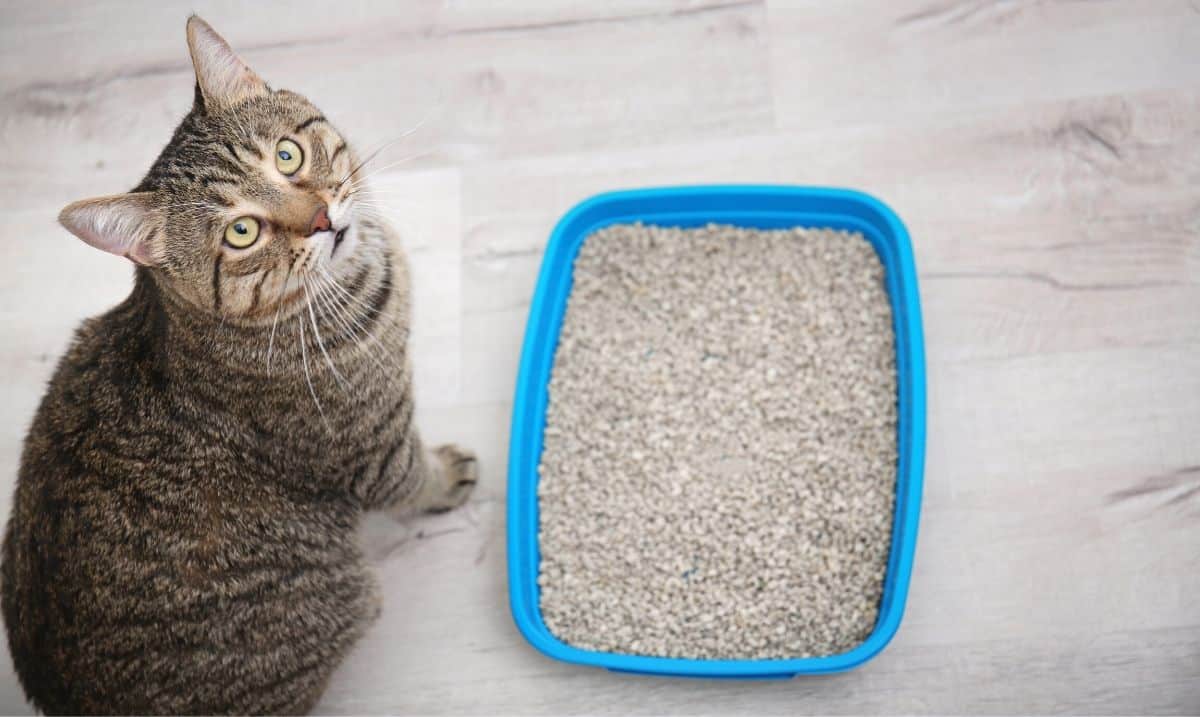
Why Is My Cat Eating Litter?
If your cat has started eating kitty litter, pay attention! Not only is this a dirty habit, but it can be dangerous to your cat’s health. Today, I am going to break down the most common explanations for a cat eating litter as well as solutions to put an end to it quickly.
Disclosure: This post may contain affiliate links, meaning I will earn a commission if you purchase through my links, at no cost to you. For more info, Please read my full Disclosure.
You may be surprised to hear that the habit of eating litter isn’t entirely uncommon.
In fact, many young kittens (approximately 3 months old and younger) will engage in this behaviour out of curiosity.
They don’t know better as they are exploring their surroundings.
Just like human babies, you have to watch them closely, as they will put anything in their mouths!
However, if your older cat has recently started eating litter, it may be a sign of an underlying medical condition or a vitamin deficiency.
Whatever the cause, this is a habit that you are going to want to stop quickly.
Eating clumping cat litter may lead to intestinal blockages as the litter clumps together within their system.
Intestinal blockages and obstructions are very serious and can even be fatal.
In order to stop this bad habit quickly, you must first identify the underlying reason why it started to begin with.

Why Is My Cat Eating Litter? Check Out These 7 Common Causes
Dietary Deficiency
There are several nutritional deficiencies that could trigger litter eating.
This is especially true if your cat is using a clay-based litter, as the litter itself contains minerals that could work to compensate for the deficiency.
Deficiencies that may lead to litter eating include:
- Vitamin A
- Vitamin B1 (Thiamine)
- Magnesium
- Sodium
- L-Carnitine
- Pyruvate Kinase
- Taurine
Speak with your veterinarian or a veterinary nutritionist to review your cat’s current food.
This can be addressed through dietary changes or the introduction of supplements.
Anemia
Feline anemia refers to a lack of red blood cells and/or hemoglobin in a cat’s blood.
Unlike the other options listed here, anemia itself is not the root cause – Instead, it is a symptom of another condition.
Signs of anemia include:
- Pale Gums
- Lack of Energy
- Weakness
- Rapid Breathing
- Pale Skin
- Fever
If you recognize any of these symptoms, contact your veterinarian.
Most causes of anemia can be treated by your veterinarian.
Potential causes include worms, intestinal parasites, autoimmune disease, nutritional imbalances and cancer.
Related: ‘Keep Your Kitty Happy with These 11 Entertainment Videos for Cats!‘
Kidney Disease
As your cat gets older, his/her kidneys may become less efficient, forcing them to work harder in order to maintain your cat’s health.
For this reason, kidney disease is more common in senior cats.
In addition to litter eating, signs and symptoms of kidney disease include:
- Weight Loss
- Vomiting
- Weakness
- Depression/Withdrawal
If you notice any of these signs in your cat, contact your veterinarian as soon as possible.
After conducting the necessary tests, your veterinarian will have a better idea of your cat’s current kidney function.
They will then be able to make a plan of action to address their health moving forward.
Feline Leukemia Virus (FeLV)
Another condition that can lead to anemia and, in turn, litter eating is feline leukemia virus.
This is due to the fact that the virus directly impacts your cat’s bone marrow and blood production.
The signs of feline leukemia are similar to those associated with kidney disease, with the addition of diarrhea and fever.
FeLV is one of the most common infectious diseases in cats.
There is no known cure for FeLV, however, there are options to help manage the virus.
If you have any questions or are concerned that your cat may be showing signs of FeLV, contact your veterinarian.

Stress or Anxiety
Have you recently made any major changes in your cat’s life such as a new home or a new addition to the family?
If your cat is struggling with anxiety or stress, it can manifest as pica.
This is not overly common, however, if your veterinarian has ruled out a physical ailment, it is worth consideration.
It should be noted that anxiety in cats can also be the result of not receiving enough attention.
Boredom
If your cat is overly bored, this could lead to litter eating as a coping mechanism.
Luckily, this is a cause that is easy to address compared to many others that are on this list.
The key is to find something that will distract your cat from the litter, providing some form of mental or physical stimulation.
For some cats, this can be accomplished by providing new toys such as a catnip mouse, crinkle ball or a food puzzle toy.
Another popular distraction (with additional health benefits) is a pot of cat grass.
Your cat should be provided with at least 20 minutes of active playtime every day in order to avoid boredom.
Related: ‘How to Stop Your Cat from Scratching Furniture‘
Pica
Occasionally cats choose to eat nonedible materials simply due to a behavioural urge.
This is known as Pica Syndrome.
While there are many theories regarding the cause of pica, experts have been unable to determine exactly why cats start to engage in this behaviour.
In addition to litter, cats suffering with pica syndrome may eat items like hair elastics, cardboard, wool, paper or plastic.
Most cats will grow out of this behaviour, but they should be monitored to avoid health complications.
Kittens and Cat Litter
Going back to the point made at the start of this article, it is not uncommon for kittens to eat litter out of curiosity.
Just as with adult cats, this can be very dangerous.
Consider using non-clumping cat litter with young kittens to reduce the risk of blockages.
Monitor young kittens when they are using the box.
If your notice your kitten is ingesting litter, make sure that they are finished ‘doing their business’ and then remove them from the box.
Have you ever faced the struggle of a cat eating litter? If so, what steps did you take to prioritize your cat’s health and safety?

I had no idea cats did this! Not ever noticed my two doing it xx
It’s not something that is overly common in adult cats. Kittens regularly do it when they are really young, but as cats get older, it’s a sign that something’s wrong.
This is some great information that cat lovers should know. Thanks for sharing and joining the Pet Parade.
Thank you!
This was very informative. I’ll keep an eye on my friend’s cat now, since I don’t have any pets of my own (only my plant). Thanks for sharing!
Thank you!
I never realised cats ate their litter – luckily none of ours ever have but thank you for raising awareness of this, Britt, it’s good to know. Both the signs to look for and the range of possible underlying symptoms. Thank you!
I’m glad that you haven’t had to deal with it – it can be a really frustrating experience.
very useful post. I know it a very common issue with cats
Unfortunately, I think a lot of people overlook the potential health risks involved with it.
Oh wow, I have not heard of this happening before. None of our cats ate their cat litter thankfully.
That’s a good thing! It doesn’t generally happen for no reason – a cat starting to eat litter is generally a sign that something is wrong.
Definitely a nutritional deficiency the same way some people chew paper, rubber or it could be psychological, like in humans.
It can definitely be triggered by nutritional deficiency or psychological reasons. However, in cats, there are also some other medical conditions to consider.
That really was great info, we’ll pay attention but so far nobody here thinks the litter is tasty!
That’s a good thing! If it does come up, make sure to address it as soon as you notice. It could be a sign of a bigger issue.
Oh my, what terribly sad and heartbreaking reasons for a cat to do such a strange thing! If I ever saw a cat doing this, I would just be confused, but after reading this, I would now be freaked out and immediately take it to the vet – which I guess is a good thing. But wow.
It can definitely be a sign of a deeper issue. The best bet is to take the cat to the vet so that you can rule out the more serious potential causes. After that, you can start assessing what your cat is eating, reasons for stress, etc.
one of my cats when she was a kitten she had this dirty habit. Before we took it home she was in the foster at someone and she looked very malnourished. I am really grateful that she stop doing this, now she is 4, happy and healthy.
It sounds like that was definitely a case of dietary deficiency. I am glad that she was able to find a home where she is loved and cared for so that she could overcome that.
I love your posts omg. Lol. I feel like I relate with every single one. My cat Bubby loves plastic! If he hears the sound of it he comes and will try to chew on it. If it is loose he will grab it and run so we have to chase him down. We keep it away from him, but every now and then we get some kind of wrapper that falls to the ground and he snags it. Thanks for explaining this kind of behavior or what may cause it.
He is lucky that he has a family that cares for him so much that you’re able to recognize this and take steps to keep him safe!
My sister’s cat did this when he was really small – he was a rescue and sounds like he was having stomach issues. He’s an outside cat now so there is no litter trey in the house but she’s a veterinary nurse so she knows what to look out for!
Rosie
I’m glad that he had someone that cared for him and was familiar with what to watch for!
Interesting read for sure. I have never owned a cat and didn’t realize that eating litter is something they do.
It’s not overly common with adult cats, but it is a clear sign that something is going on.
Fortunately for me, my cats don’t eat litter but I find this info quite useful. Might come in handy someday.
I’m glad to hear that you haven’t had to deal with this!
Thankfully, none of my cats have ever eaten litter! I didn’t even know it was a fairly common thing, so thank you for this post because I am now aware to look out for any litter eating!
It’s definitely something to keep an eye on. Always better to be prepared and aware of the risks before something happens. Right?
Though I don’t have a cat with me, my friend does and we’ve seen her cat doing this off recent and that’s what got me to read this post. Thank you for eloquently explaining what might be the reasons for such behaviour. This is quite helpful!
I’m glad that I was able to offer some insight into what might be happening with your friend’s cat. It can definitely be a sign of something far more serious, so it’s not a habit that should be ignored.