
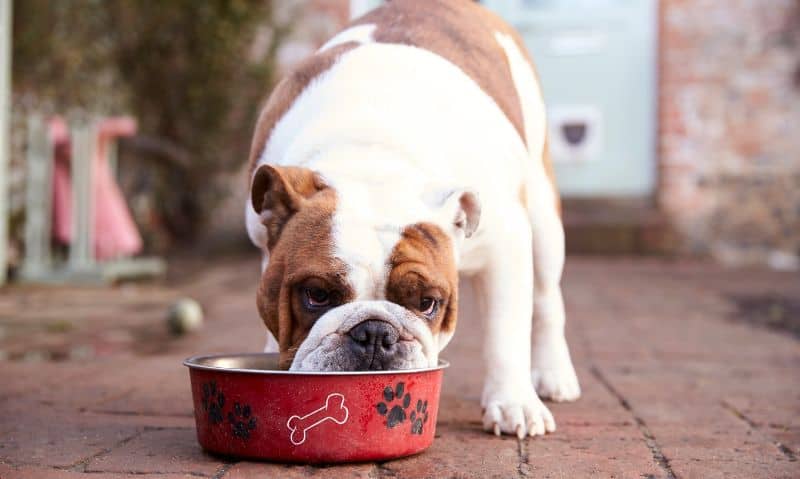
Help! My Dog is Eating Too Fast!
It’s a common struggle faced by dog owners everywhere. However, a dog that eats too quickly is at risk for a number of serious health concerns. This is a bad habit that you should squash, and fast! Try these tricks to slow mealtime down if your dog is eating too fast.
Disclosure: This post may contain affiliate links, meaning I will earn a commission if you purchase through my links, at no cost to you. For more info, Please read my full Disclosure.
It’s dinnertime and you’re serving up your dog’s favourite food.
However, you can’t help but wonder if they even taste it as they inhale every morsel in 10 seconds flat.
You try telling your pup to ‘slow down’ or ‘take a breather’ but, all your pleas fall on deaf ears.
While this may appear to be funny at first, it isn’t long before most dog owners find themselves concerned with their pup’s bad habit.
Don’t worry, you’re not alone!
Our boy Indy is a fast eater, tearing through every meal as if he hasn’t eaten in days.
Spoiler – He’s fed 4 times every day…
The good news is that there are solutions available!
Why Is My Dog Eating So Fast?
The first step to curbing your dog’s poor mealtime manners may lie in understanding why they feel the need to eat their meals at such a rapid pace.
Sure, it’s possible that they may just love their food that much.
However, it may also be a sign of a deeper problem.
Uncertainty from the Past
If your dog came from a situation where they weren’t sure when their next meal was coming, this may impact their eating habits today.
This is particularly common in former strays or those coming from neglectful homes.
While the reflection on this aspect of your dog’s past can be sad, don’t forget that they are now in a loving home with you!
Related: ‘12 Easy Ways to Save Money on Pet Food‘
Competition for Food
Do you have more than one dog?
If so, your dog may feel like he/she has to eat quickly or risk someone else taking their food away from them.
This may also be a reflection of similar competition in the past with littermates.
Some dogs may even believe that cats or people are interested in taking their food away.
Nutritional Deficiencies
The quality of your dog’s food may have an impact on how quickly they eat.
Some foods fail to meet your dog’s nutritional needs, leaving them deficient in key areas.
As a reaction to this deficiency, your dog may eat their food rapidly, trying to satisfy their own needs as quickly as possible.
Underlying Health Concerns
Finally, this may be a sign of a deeper problem.
Parasites like roundworms can lead to your dog suffering from malnourishment.
This, in turn, can trigger a response like the nutritional deficiencies discussed in the last point.
Another concern that is worth mentioning is diabetes, which can trigger an increased appetite and encourage eating faster in an attempt to satisfy it.
If you are concerned about potential health concerns, contact your veterinarian.
Risks of Eating Too Quickly
The obvious risk, as mentioned above, is that your dog’s eating habits are a reflection of an underlying health issue.
However, there are additional problems that can arise from inhaling their food.
The most common concern that most pet owners worry about pertains to basic digestive problems.
If you have ever eaten too quickly, you may be familiar with the upset stomach that often follows. This is a problem that your dog may face as well.
In addition to an upset stomach, this may also trigger vomiting.
A dog that eats their food so quickly that they fail to chew it properly is also at risk for choking.
Finally, and the biggest concern that many veterinary professionals have, eating food too quickly can lead to a condition called Gastric Dilation-Volvulus (GDV, otherwise known as ‘Bloat’).
GDV is often caused by a build-up of food (from a large meal) and gas in a dog’s stomach, causing it to expand.
It can then put pressure on other organs in the body, restricting blood flow or marking it difficult for your dog to breathe.
The stomach may also twist or rotate, cutting off blood flow entirely from the stomach to the heart.
Signs of GDV include:
- Pacing/Restlessness
- Drool
- Swollen Abdomen
- Anxiety
- Unsuccessfully Attempting to Vomit
- Pale Gums
- Shortness of Breath
- Rapid Heartbeat
- Weakness/Collapse
If you believe that your dog is exhibiting signs of GDV, you need to get them to the nearest veterinarian or emergency clinic immediately. Do NOT hesitate!
GDV can be fatal and it moves quickly. Your dog’s best chances for survival are to have a professional address it as soon as possible.
Related: ‘Easy 3 Ingredient Peanut Butter Banana Dog Treats‘
If Your Dog is Eating Too Fast, Slow Them Down with These Tricks
Luckily, there are some great solutions available to slow your dog down and prevent unnecessary health-related complications.
There is no ‘best’ solution. Instead, it’s about finding which solution is best for you and your dog!
You may also combine some of these tricks for better results.
Feed Smaller Meals
Rather than feeding your dog 1 or 2 large meals, break his/her feeding schedule down into multiple smaller meals throughout the day.
We currently feed our dogs 4 times a day, limiting how much food they get each meal.
Not only does this help to slow your dog down by cutting down on the time between meals (meaning that they aren’t as hungry heading into meal time) but it has been shown that smaller meals can help to decrease your dog’s risk of GDV.
Ensure You Are Feeding A High-Quality Food
Take the time to look into the food that you are feeding your dog and whether or not it is meeting your dog’s nutritional needs.
As we mentioned above, if your dog is eating too fast, it could be a sign that he/she is experiencing a nutritional deficiency.
Read the ingredients carefully. Are the first ingredients high-quality, providing nutritional value, or are they fillers like corn?
Consider your dog’s unique needs including their age, breed, activity level and dietary concerns.
Still unsure? Contact your veterinarian and ask for their recommendation.
Purchase A Slow Feeder Bowl
There are many different slow-feeder bowls currently on the market.
These bowls are built with obstacles within the bowl, forcing your dog to slow down as he/she has to eat around it.
You can also purchase obstacles that you can place within your dog’s existing bowl, turning a regular bowl into a slow feeder like the Gobble Stopper.
Just be sure that your dog can’t simply remove the obstacle before chowing down.
Personally, we use (and love) the line of slow-feeder dishes manufactured by Outward Hound.
Our boy Indy is a speed eater, he always has been.
However, since introducing his Outward Hound Slow Feeder dish, it has slowed him down considerably.


Create Your Own ‘Slow Feeder’ Bowl
If budget is a concern, there are options to DIY your own slow feeder bowl.
The two most common solutions include placing a smaller dish upside down in your dog’s current dish, forcing him/her to eat around it, or adding an obstacle like tennis balls.
Be cautious of the size of the obstacles that you are choosing.
Adding a small obstacle could lead to your dog accidentally swallowing the obstacle, causing him/her to choke.
Use Food Puzzle or Food Toys
Another great way to slow your dog’s eating down while making mealtime fun is to use a food puzzle or food/treat toy.
These options force your dog to work for their food rather than just giving it to them outright.
While this may sound ‘mean’, they are anything but!
Food puzzles provide mental stimulation as well as an outlet for your dog’s natural hunting and foraging instincts.


In addition to the puzzle-style feeders, you can purchase or create a snuffle mat.
These are softer mats or rugs with a variety of different fabric strips that your dog has to sniff and explore through in order to find their food.
Like food puzzles, these have been found to provide great mental stimulation as well as release excess energy.


Finally, there are the more traditional food toys that everyone recognizes, like the Kong.
These toys work by placing food into the toy either on its own or with a substance that holds the food in.
If there is a substance (like peanut butter) holding the food, the dog must lick the substance away to release the food.
Otherwise, food is released by moving the toy around, causing it to fall out slowly.


Feed Your Dog on A Cookie Sheet or Muffin Pan
Another low-cost alternative that you may choose to use is a regular household cookie sheet or muffin pan.
Spreading your dog’s food across a cookie sheet will slow your dog down by forcing him/her to pick up individual pieces (or smaller portions, if feeding wet/canned food) of their food with each bite.
Alternatively, you can split your dog’s food up among the cups of a muffin tray.
Your pup can only eat the food contained in a single cup at a time, slowing them down considerably.
Hand Feeding
Finally, if nothing else is working, you may choose to resort to hand-feeding your dog.
This is the most time-intensive option on the list. That being said, it is also a great opportunity to bond with your dog.
You can sit on the ground simply offering small amounts at a time by hand or turn it into a fun experience by having your dog perform tricks for food.
Not only would this process help to slow the process, but it can also double as positive reinforcement and training time.
Break down more challenging tricks into smaller steps.
This will allow you to slowly work up to the end result, making these more challenging tricks attainable.
Much like the treat puzzles/toys and snuffle mats, this offers much-needed mental stimulation for your dog as well as an opportunity to ‘burn off’ some energy.
Do you struggle with a dog that’s eating too fast? If so, what solutions do you rely on to help slow him/her down?

These are amazing ideas to keep a dog from eating too fast! I love these types of bowls. I’ve seen some funny videos of dogs dumping them over sometimes. So it definitely would be a trial and error type thing. My cat even eats too fast sometimes so he now has a timed auto feeder. Animals always keep things interesting, that’s for sure!
Indy has tried to dump his a few times, so I always watch him closely when he’s eating lol
Most of the dogs I seen eating do so very quickly to the point where I thought it was normal! I’m learning so much about dogs because of you. It’s making me want to a get a little puppy of my own! Do you have a guide for people considering?
I do! I actually have a downloadable new puppy checklist that you can print that walks you through a lot of important information as well as other new pet resources here: https://shedhappens.net/new-pet/
This was so interesting, I love the look of the little games and puzzles to help them slow down, great mental stimulation for them too. Hugo has never been that quick of an eater when it comes to meal times. We’ve always left a bowl down for him and allowed him to feed intuitively when he’s hungry so there’s never been a demand issue for him. But he can gulp treats or human food (when he gets a little) down a bit too quickly, then he tries to run/ play and ends up making himself sick ?♀️x
Sophie
It’s definitely a good idea to keep dogs settled for a bit after eating. Running and playing right after eating can cause problems. I know, easier said than done!
My dog eats so fast! He always has but he just LOVES food. Like, he’s obsessed with food. There’s nothing wrong with him – he just likes to eat haha! Bit like his owner really!
I think that’s the issue with Indy more than anything. Unfortunately, it’s still a risky bad habit that we’ve had to try to find a way to keep under control. We’re lucky that his slow feeder dish really does help to slow him down.
Hmm, now that I think of it – I think that whenever I see dogs in films/videos of dogs the dogs are always eating fast – I didn’t realize there was like a proper way/speed for dogs to eat at.
The thing with dogs is that they very much understand what you’re saying!
These are all great tips to watch out for for dog owners – I don’t have a dog but this was super interesting to read! The feed smaller meals section is also something recommenced for us humans haha – rather than having 2 large meals, to spread it out!
Great post!
Sahara
This is definitely something that I had to learn as a dog owner. Early on, I shrugged off the speed-eating until I learned of the risks that it exposed my dogs to. Now, I’m much more aware of what I should be doing to slow them down.
I definitely can’t wait to get a dog! This is such good information!
I can’t imagine our lives without our dogs. They are such a special part of our family.
I’ve heard some really good things about puzzles to slow down how dogs eat, as a friend of mine has a rescue dog and it was the only way they could get him to slow down with his eating x
They are a great option to help slow a dog down. We’ve been lucky, the slow feeder dishes seem to be working for now. That being said, Indy has started experimenting with dumping his dish. We might have to try changing it up in the near future…
These are all great suggestions. Our dog was a fast eater so we fed her several times a day which helped, but I reckon she’d have loved one of those puzzle feeding dishes!
It’s surprising how many dogs try to inhale their food. It’s a bigger problem than most people realize!
Great suggestions! Our dog used to eat so fast, and when I took him to the vet we mentioned it a few times. We were surprised that she didn’t really have many suggestions for us. You provided some great ones! Thank you for sharing.
That is surprising! Most veterinarians are armed with suggestions to help dog owners take control of this.
I never knew it could be such a problem for dogs to eat quickly! I have seen the mats before to eat off of but didn’t know it was such a big thing x
It is far too common and can be super dangerous.
This was so informative! I always learn so, so much from your posts. I used to have a few pups who I can tell had some trauma in their pasts. It’s nice to know now that their past experiences might have an impact on their eating habits, even!
It can definitely have an impact on their eating habits, especially if their experiences had anything to do with their access to adequate food.
This perfectly describes the dog we puppy-sat this weekend! She got into my dogs food and ate it so fast she threw it all up and it looked hardly chewed. Whoops! She’s an old lady dog now but she was a stray as a puppy as you said. I could see those puzzle food balls being perfect for her.
My dog is the opposite of this. She has a genetic stomach problem where the lining of her stomach is thickened so that her stomach is very small. We have a hard time getting her to eat as much as she should even though she’s incredibly active. We actually free feed her so that she can eat when she feels good, and she still doesn’t eat all her food some days. ?♀️ We had to switch to more calorically dense food for her so she didn’t have to eat as much volume.
The dog you puppy-sat sounds like she’s the female version of our boy Indy! I’ve never had a dog inhale food the way he does.
I’m glad that you were able to find a calorically dense food that will work better for your dog.
I must admit the title of this post made me laugh, but now I’ve read it I realise it’s a serious issue! I’ve never had a dog so I had no idea why they sometimes eat fast and the dangers of it, but I wonder if a similar thing is true for cats because my cat does eat quite fast! I love the idea of the slow feeder bowl and the snuffle mat.
It’s not as common in cats but definitely just as serious! There are little slow feeder dishes and other resources aimed at slowing cats down too.
What a very helpful insight! I’ve never faced these such problems because I’ve never had dogs! But maybe this is also applicable to cats since I got two cats?
This is definitely applicable to cats too. Cats are less likely to have a problem with eating quickly, but it can happen and it can still make them sick. There are slow feeder dishes specifically marketed to cats!
I’ve heard great things about those puzzle bowls you bought for Indy! The rug the dog has to search through is a new one to me though. That looks interesting, to say the least. I honestly always used to think that eating quickly was a pretty normal thing. so I hadn’t thought much about it, other than they may throw it all back up occasionally. Like that was the worst thing that would come from eating too quickly. I’m glad I know so much more about it now though.
I used to think the same way, so I didn’t think too much about it when I saw dogs doing it in the past. However, since learning how dangerous it can actually be, I am much more aware of how quickly our dogs are eating and what we can do to slow them down.
My elder eats very fast as well. I swear by low feeding bowls and puzzles. I hear it’s good for dementia and I am personally afraid my pups might get it
We use slow feeder bowls for both of our dogs right now. Technically Dav girl doesn’t ‘need’ one, she eats really slow all on her own, but it’s a great way to make eating a game and provide a little mental stimulation.
We had the opposite problem with our pet, he was taking all day long to eat his one meal! Thankfully adding a little warm water to his dry food seemed to do the trick and he no longer strings eating out all day! x
That’s a great tip. We’ve used that in the past with our girl Dav to entice her to eat more. It creates a ‘gravy’ that she really enjoys.
I have the exact opposite problem! He sometimes doesn’t eat his breakfast until dinner and will eat it at one time.
Slower eating is definitely a benefit, although as your dog gets older, you may want to try to entice him to spread it out a little more if his stomach has a harder time handling it all at once.
Interesting! I always thought dogs ate fast naturally. I’ve never seen a slow eater dog unless they’re elderly, and of course, with medical issues. Great tips for pup parents!
Our girl Dav has always been great about eating slow. On the flip side, Indy boy INHALES his food unless we do something to slow him down.
One of our previous dogs ate her food in 2s flat! We got her a slow feeder bowl. Really helped!
It’s impressive to see how well the slow feeder bowls work, isn’t it? It’s like night and day for our boy Indiana!
This is such a great post. It is so important to keep a look out for their dogs eating habits and help where required x
It is, the risks are far too high not to!
Having zero knowledge on taking care of dogs, this is all something new to me! I never knew there’s such a thing as GDV! It’s really important to pay closer attention to their eating habits
It’s a very serious risk that can quickly turn fatal. Definitely important to be aware of the signs, what to do and how to prevent it.
Oh poor little doggos! My sister’s dog gets sooo excited for her food after a walk that she does the same. I’ll pass this post on over to her to give her some advice!
Rosie
In some cases, that’s all it takes – excitement lol
Thank you for sharing these tips. My little dog eats really fast with no chewing. I am not really sure what’s the reason since she really doesn’t need to compete for food since her parents (the other 2 dogs at home) are picky eaters that I have to beg them to eat.
Anyway, thank you for sharing these tips. I will make sure to give her smaller but more frequent meals throughout the day.
It sounds like she may benefit from trying one of the other feeding options, such as a treat feeder or a slow feeder dish. Our boy Indy eats in the same way. The only way we’ve found to slow him down was to start using the slow feeder. Otherwise, he just inhales it.