
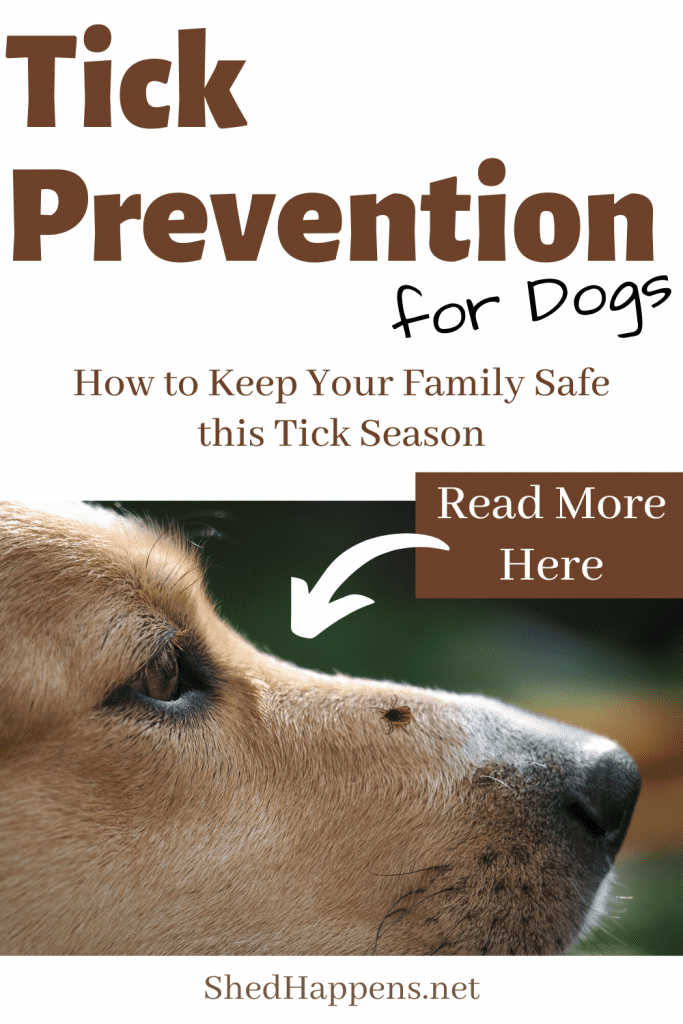
Tick Prevention for Dogs: How to Keep Your Family Safe this Tick Season
Well, it’s that time of year again! The sun is coming out, the temperatures are rising and there is nothing we want to do more than spend all our spare time outside. Unfortunately, it is also time to start worrying about ticks! As a responsible pet owner, it’s important to educate yourself on the risks associated with tick season as well as the details regarding tick prevention for dogs.
Disclosure: This post may contain affiliate links, meaning I will earn a commission if you purchase through my links, at no cost to you. For more info, Please read my full Disclosure.
Whether you are hiking your favourite trails or even just relaxing in your backyard, you are at risk of picking up these unwelcome hitchhikers. It’s important to remember, however, that ticks aren’t just a nuisance – These pests can also pose significant health risks. In order to keep our families safe, we need to ensure that we familiarize ourselves with the potential risks, the steps that we can take to prevent a tick bite as well as what we should do in the event we have been bitten (including how to safely remove a tick).
Are you ready to dig in? Let’s start with the basics…
WHAT IS A TICK?
Before we start discussing the details of tick prevention for dogs, let’s first take a look at what we’re dealing with. What exactly IS a tick and why should we be concerned about their presence?
Ticks are members of the arachnid family, the same family that includes spiders and mites. They are small external parasites, feeding on the blood of their host which includes both animals and humans. They go through a series of life stages, much like other arachnids. Adult ticks lay eggs that hatch into larvae, the larvae in time moult into nymphs and nymphs mature into adults who repeat the process by in turn laying more eggs. Depending on the species of tick this life cycle can take anywhere from 2 months to more than 2 years.
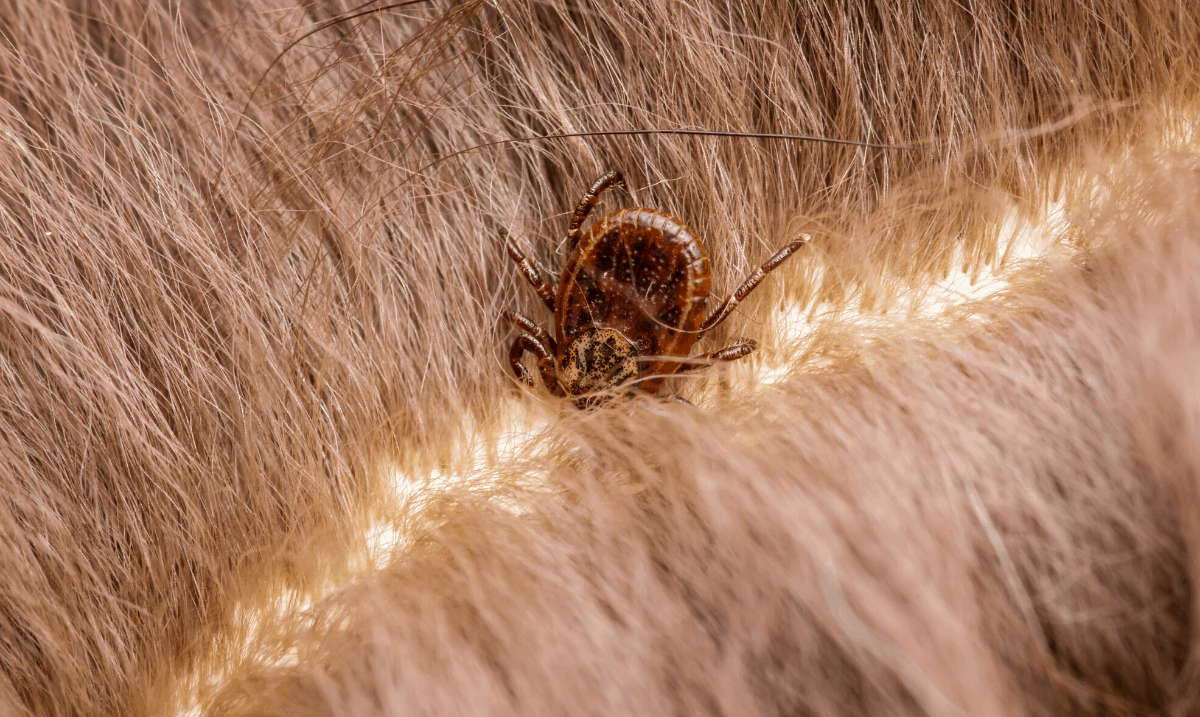
Both adult ticks and nymphs can carry a number of diseases, including Lyme disease, which can be transmitted to you and your dog when they attach and feed. While there are at least 15 species of ticks found in North America, you are likely to only encounter a few species, including:
- American Dog Tick: The American Dog Tick is most often found in drier habitats where there are tall grasses, such as open fields. They are carriers for Rocky Mountain Spotted Fever as well as other diseases.
- Deer or Blacklegged Tick: The Deer or Blacklegged requires moist habitats to survive, such as tall, wet grass or leaf litter located in wooded areas. This the species that is known for carrying Lyme disease as well as Anaplasmosis, Babesiosis and a few others.
- Brown Dog Tick: Unlike the other species listed, the Brown Dog Tick needs warm, protected indoor locations where there are dogs (their preferred host). They are less likely to be found in the colder climates, however, have been seen across the province. They are carriers of Rocky Mountain Spotted Fever, Babesiosis and Ehrlichiosis.
While one could argue that ticks have always been here, the number of ticks found in Canada is on the rise! This means that we are all at a higher risk of being exposed, meaning that it is is more important now than ever to be sure that you are familiar with how to spot a tick, what steps you can take to protect yourself and your dogs when you are outdoors and what to do if you spot a tick.
Related: ‘10 Tips for Your Dog’s First Camping Trip‘
WHAT IS LYME DISEASE?
Lyme disease is an infectious disease that is caused by exposure to Borrelia Burgdorferi, a type of bacteria that is carried by ticks and lice. More specifically, the Borrelia bacterium can be found in deer or black-legged ticks. This bacteria is transmitted from the tick into the bloodstream of its host when it is attached and feeding, highlighting the cause for concern.
The signs and symptoms of Lyme disease are quite varied, making it difficult to identify early on. Further adding to the challenge, it may take weeks or months for some symptoms to show. Early symptoms that will be seen in the first 3 to 30 days include a rash at the site of the bite which continues to grow and spread up to 12 inches across, fever, chills, headaches, body aches, neck stiffness, and a feeling of tiredness/fatigue. In time, additional systems may start to surface including joint pain or swelling, temporary paralysis on one side of the face (known as Bell’s palsy), weakness in the limbs or impaired muscle movement, feelings of numbness or growth of the rash in other areas of the body.
Common signs and symptoms to watch for in your dog include reduced energy/fatigue, fever, stiffness/discomfort, lameness, swollen joints, unexplained pain, and loss of appetite.
In more extreme cases, Lyme disease can also lead to liver, kidney, heart, and advanced neurological complications.
The symptoms may appear to clear up on their own, but this is not a sign that you are in the clear. The disease can continue to spread and grow without showing symptoms for a long period of time. If you suspect that you or your dog have been bitten by a tick and may have transmitted the disease, it’s important to contact a medical/veterinary professional as soon as possible. Your best chance for success is early treatment!
WHERE ARE WE AT RISK?
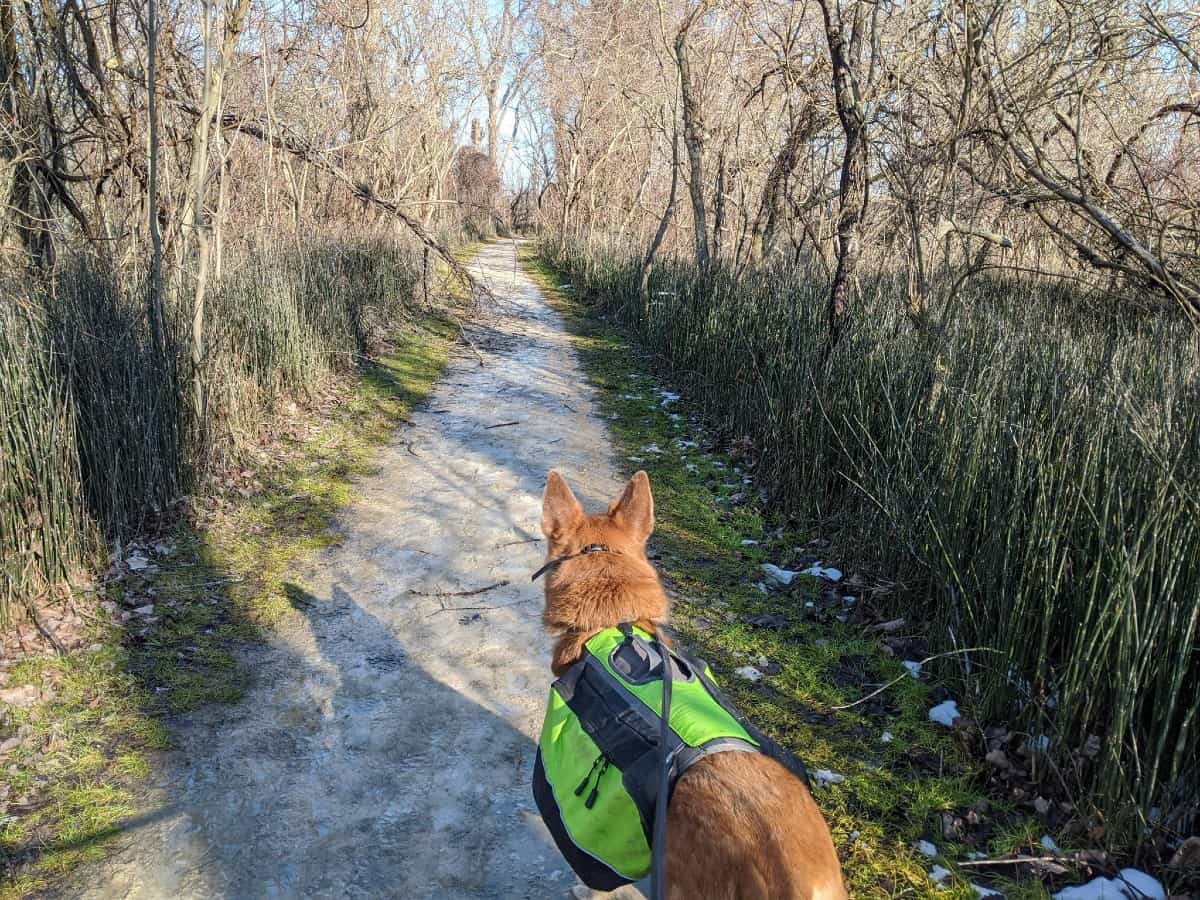
Ticks are most often found in areas of ‘natural growth’ which include overgrown grass, marshes, thick brush and heavy weeds. This especially includes locations such as nature preserves, parks, the edges of hiking trails, and forested or field areas that don’t receive regular maintenance.
Note: Your own yard can be considered high-risk if you allow areas of the yard to become overgrown or unkempt.
Most species of ticks use the same process to find their host (animal/human they are going to feed off). This is an ‘ambush’ style approach. The tick climbs to the tip of a blade of grass or brush and as the host walks past, brushing against the vegetation, they simply let go and climb aboard. When they first climb aboard their host they wander around, either looking for a mate or the best place to feed depending on the species.
Despite the common misconception, ticks cannot jump or fly – they can only crawl.
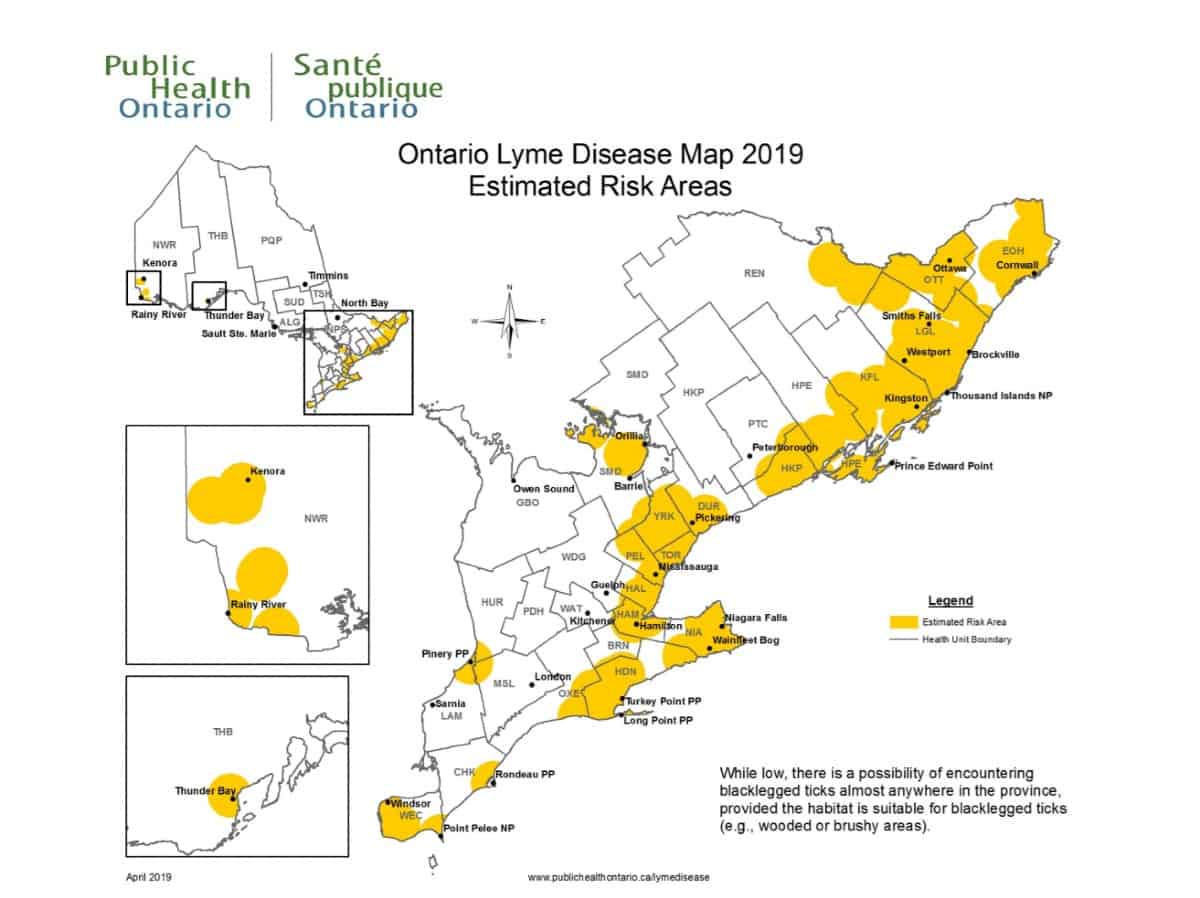
There is no ‘tick-free’ area here in the province of Ontario, however, there are certainly some areas that do carry a much higher risk of exposure both to ticks in general as well as specifically to those ticks associated with Lyme disease. The Public Health Ontario Estimated Risk Areas map highlights the areas of the province where we are at the highest risk of exposure. That being said, we need to remain diligent regardless of where we are outdoors.
The best form of tick prevention for dogs is to acknowledge the risk!
WHAT SHOULD I WATCH FOR?
Anytime that you return from time outdoors with your dog, it is important to conduct a thorough tick check. This includes not only checking over your dog but also your clothing and yourself. Remember, a tick does not immediately latch on when it comes in contact with a host, so you are looking both for ticks that have attached as well as those that are still wandering.
When checking your dog, ticks are most often found on the ears (both sides of the ear flap or in the opening to the ear canal), the lips, on the face, in the armpits and on or between the toes. These, however, are not the only areas you may find a tick hiding out. Look closely, separate the fur and check the skin across your dog’s entire body to the best of your ability.
As for yourself, or your children, ticks gravitate towards areas where there is hair, or where there are gaps in your clothing.
In the days and weeks that follow, you should continue to monitor yourself and your dog for any signs of a tick that you may have missed (they feed for approximately 3 to 10 days) as well as for signs of a tick bite. These bites often resemble a ‘bullseye’ on the skin – a red bite mark with rings of red and swollen skin surrounding it. Usually painless, it is not uncommon for a tick bite to go unnoticed.
Related: ‘Must-Have Camping Gear for Dogs‘
TICK PREVENTION FOR DOGS: WHAT CAN I DO?
There are a number of products available specifically marketed as tick prevention for dogs including Advantix from Bayer and Revolution from Pfizer. Tick medications come as a topical product (applied to your dog’s skin), oral (ingested) or infused in a collar. I highly suggest having an in-depth discussion with your Veterinarian to help decide the best course of action for your pet. Don’t be afraid to ask questions – Your vet has your pet’s health in mind and will be happy to help you learn what you need to in order to do your best job in protecting them.
Remember, however, that there are no products on the market that are 100% effective in tick prevention! It is important to still conduct a thorough tick check, as previously discussed, any time that you spend time outdoors.
In addition to ensuring that your dog is being treated with reliable tick prevention, additional preventative measures include:
- Lawn Maintenance: Keep your lawn cut as short as possible including addressing any long grass or brush at the edges of your lawn.
- Leaf Piles: Remove all leaf piles and leaf litter from your yard.
- Firewood: Stack any firewood neatly and in a dry area of the yard to prevent rodents that may be carrying ticks into your yard.
- Clutter: Remove any garbage, mattresses or old lawn furniture from your yard as these provide hiding places for both rodents and ticks.
- Create a Tick Barrier: If your property is bordered by a high-risk tick zone like a forest, you can create a barrier to prevent ticks from migrating into your yard. A tick barrier is a 3-foot section of gravel or wood chips placed directly between the yard and the risk zone.
- Meticulous Tick Checks: I have said it a few times, but I can’t say it often enough. Check your dog over carefully EVERY time that he/she has been outside in an area where ticks may be present.
WHAT DO I DO IF I SPOT A TICK?
This is a great video I came across from Monica Seto, the Manager of Shelter Health and wellness for the Ontario SPCA discussing tick prevention for dogs and how to safely remove a tick:
To remove a tick, you will need rubber gloves, a plastic bag or container to dispose of the tick and either blunt tweezers or a special tick removal tool. I highly recommend picking up the tick removal tool as tweezers run the risk of crushing the tick, releasing any disease they may be carrying.
Ensure that you are wearing your gloves throughout the ENTIRE process, not removing them until the tick has been completely disposed of. Contact with the tick to your skin increases your chance of exposure to any diseases that it may be carrying.
If you are using a tick removal tool, approach the tick from the side, sliding the tool along the skin with the tick between the two prongs. Gently lift and turn the tool until the tick releases its hold.
If you are using tweezers, grasp the tick as close to the skin’s surface as you can without grasping onto the head directly. Apply steady, even pressure while pulling the tick straight out, avoiding any twisting or jerking movements as this may cause the mouthparts to break off and remain in the skin. The tick may not release immediately, so continue to apply pressure until it does!
Place the tick in a plastic container with a secure lid such as a pill bottle. You can then contact your local public health unit for testing. This will allow officials to test for any diseases that the tick may be carrying. Alternatively, you can choose to dispose of the tick. This can be done by placing it in a plastic bag, sealing it and wrapping it tightly in tape, submerging it in alcohol or flushing it down the toilet.
Disinfect the bite area by washing both the affected area and your hands with soap and water.
There are many other suggested ‘home remedies’ for tick removal that can be found online but exercise caution! Remedies such as applying petroleum jelly, grease or the use of a hot match on the tick can increase your risk as these methods irritate the tick, causing them to release an increased amount of saliva into the body. If this tick is a carrier of the Borrelia bacterium, this would greatly escalate your exposure.
Did you learn anything new about tick prevention for dogs? What steps are you taking to protect your pups this season?
Sources:
American Kennel Club: https://www.akc.org/expert-advice/health/lyme-disease-in-dogs/
Centers for Disease Control and Prevention: https://www.cdc.gov/ticks/prevention/preventing-ticks-on-pets.html
Government of Canada: https://www.canada.ca/en/public-health/services/diseases/lyme-disease/removing-submitting-ticks-testing.html
Mayo Clinic: https://www.mayoclinic.org/diseases-conditions/lyme-disease/symptoms-causes/syc-20374651
Public Health Ontario: https://www.publichealthontario.ca/en/diseases-and-conditions/infectious-diseases/vector-borne-zoonotic-diseases/lyme-disease

I so hate tick bites! They usually leave a mark on a person’s skin. And I’m one of those hu-hu ?
I’ve been lucky, I don’t recall ever being bit by a tick (although there’s always the possibility that we were and didn’t realize as it).
We don’t have a dog but this is great information especially since they say ticks will be plentiful this year. I will share with my dog owner friends.
Unfortunately, it looks like they are on the rise. We’ll all have to be super diligent this year.
They are horrible little things . When I worked at a vets my most hated jobs was tick removal and picking maggots out of open wounds.
They really are – all we can do is to do our best to keep our pups safe!
We don’t have a dog but thanks for the tips. We are thinking of getting one or two after the pandemic.
It looks like things may start to open up right in the middle of tick season at this rate, so make sure you’re on top of that right away! 🙂 Dogs have a tendency to want to explore new places and that includes high grassy areas (hot zones) lol
Tick Protection is so important!!! We have to keep all our fur babies safe and healthy.
Yes, it is! There is no need for them to suffer when we have the means to protect them.
This is such an informative post. Luckily we’ve never had any issues like this with our dog!
We live in a high-risk zone, so it’s something we’ve had to be aware of.
Great information about ticks. They actually give me the creeps. Deer ticks are even creepier because they are so small. The big ones are so ugly though. Yuck.
They give me the creeps too lol I’m not going to lie, I was shuddering while I was writing parts of this.
Great post! The ticks are crazy here right now. I don’t have a dog but our cat goes out a lot and it’s definitely something we watch for carefully this time of year. Thanks for the tips!
We are big hikers, so it’s something that has always been on my radar. After all, we’re literally walking into their territory.
Ticks give me the creeps. Great post with fantastic information for those that have to deal with them, I am blessed as I have not had a problem with Layla phew
We haven’t seen any on our dogs yet this year, but last year they encountered them just in our backyard, let alone when we were out camping. You can never be too careful! That’s the motto that we have taken regarding it all.
Lyme disease is no joke for sure, and there are multiple stages, the worst one causing lifelong and often debilitating symptoms. I had a friend with stage IV when it was finally diagnosed. It amazes me how quickly and easily ticks attach to us and our pets! Th==
Yes! I think a lot of people shrug off ticks as just being a disgusting and annoying pest, but they fail to take a step back and recognize just how dangerous they can be!
I’m definitely sharing this post with my niece. She just moved and will be walking her dog in a lovely park a few times a week. This is great information for her.
Yes, they seem to be pretty prevalent this year in most areas, including public parks. The best thing that we can do is to stay informed and take steps to keep our dogs safe.
This is such good advice for tick prevention. Getting into the habit of checking your dogs coat especially after walking in long grass is really important.
Those little buggers can cause some serious harm if they are left unchecked!
We are seeing more and more ticks when we go camping. Very good info!
They definitely seem to be running rampant this year, don’t they? I have seen so many people posting about the large number of ticks that they are encountering while out hiking or even walking their dogs.
I hate blood suckers. Around here, the moose have lots of ticks but our vet said those don’t go on dogs. That is a big relief. This year, we’re testing a “sonic” collar attachment. I don’t know how it’s gonna work but I know it won’t hurt my dog. And we’ll go from there.
I would love to hear your experience with the sonic collar attachment after you’ve had a chance to try it out for a while!
Ticks are just horrible. And you are so right, even with preventatives, it’s not 100% foolproof. I had two Huskies who tested for anaplasmosis even though they were always on a preventative and tested negative every year prior. Huskies are tough ones to find ticks on, but checking is so important as well as keeping preventatives going. Great info on what to do. Pinning to share! And here is to a (hopefully) tick-free season!
We have a hard time finding them on our boy Indy too. He has long black hair, so they hide out so easily. We keep the preventative up, but as you said, it’s not always foolproof so tick checks are a regular part of our hiking and camping trips.
You answered every question that popped into my head as I read. I live in an urban environment so can be clueless about these topics!
I think a lot of people aren’t fully aware of the risks that ticks pose or what they can do to keep themselves (and their families) safe.
Your post made me itch and want to take a shower. Sheesh, these animals are revolting and dangerous. I am glad you put together some important information to help dog owners combat this * scratch scratch * menace! UGH!!
Writing it had me itching too. I can’t stand them and they are SO prevalent now. I’m seeing more and more people report that they are seeing an increase in ticks in our parks and natural spaces.
Excellent post, great information about those nasty ticks! They really do pose a danger to pets as well as to humans. Lyme Disease is no joke, it can be so debilitating. Last time we moved, several years ago, we took the dogs for a hike in a historic cemetery. Little did we know the area was infested with ticks! Our cross country move had been so chaotic, I lapsed on Icy’s tick medication for only a month or two and BAM! wouldn’t you know she got a tick on her neck that day! I didn’t catch it for several days until it was engorged, having fed on my poor dog’s blood. I vowed never to lapse on my dogs tick medication again! I now use a monthly oral preventative, Simparica Trio, that controls ticks, fleas AND heartworm. Ticks & Heartworm can both be very dangerous for pets. It scares the heck out of me, so now we have our bases covered in one monthly medication.
Love & Biscuits,
Dogs Luv Us and We Luv Them
We dropped the ball once and missed getting their tick meds updated – only to apparently discover that there were ticks in the back corner of our own backyard. We are FAR more careful about it all now.
Yech! Ticks are prevalent in the South because of our warm and humid climate. Luckily, Truffle and Brulee are indoor only. but I am well aware that I could bring ticks inside on my shoes or pants. Truffle and Brulee get a monthly treatment of Revolution Plus.
That’s our issue here as well. Many people don’t realize it, but the southernmost areas of Ontario are actually at the same latitude as Northern California. It makes it the perfect breeding ground for those unwanted critters.
I remember last year seeing a post in a neighborhood FB group that I’m in about ticks being seen on a lot of deer in the area and the sightings of them increasing. So I’ll be sharing this post in that group now! Ticks really are dangerous. I had previously wondered why they were such a big deal, but now I know so much more about them. A friend of mine is a surveyor in North Carolina, and they are a real problem there too. He gets them when he’s out working. Luckily I haven’t seen or encountered any, and I really don’t want to!
They were bad enough in our area last year that our dogs actually came across them in our backyard in the fall. It really pushed us to make sure that we’re taking every precaution that we can to keep everyone safe.
Great tips! I agree on having no places safe from ticks. For example last year my dog somehow managed to get a tick after he went shopping with me. There were very few spots with grass and or trees and he didn’t even step on it. As for favorite places I’d definitely add stifle area.
They are annoying buggers that somehow find a way even when they shouldn’t be able to…